Friday, June 15, 2012

Maurk U


Some of this post isn’t good for kids.

Hello All.  Not much of a post today.  I’m excited and nervous about my workshop, which will begin on Monday.  I feel prepared and all the arrangements have been made.  But, in Africa, things never ever go how you think they’re going to.  The question is just how not-as-planned will things go.  I’m optimistic, but I’m sure I’ll have some stories for you next week. 

I have the support of a couple other PCVs who have traveled to Rundu from their sites to help me out with any complications that might arise.  They will also be subjected to hours of my presentation practice this weekend.   

Elsewhere in the world;
Something that occurs to you when you travel in places like Myanmar is that you’ll almost certainly hear some bad news from there sooner or later.  It didn’t take long.  Those of you following my blog since my Southeast Asia travels know that I spent much of this past January there.  Recently, violence broke out in a remote region known as the Rakhine state.  Remember the tattooed faces and the guesthouse being run mostly by children?  That place.  The worst violence was in Sittwe (remember the police convention?).  Maurk U, a small, remote, beautiful riverside town surrounded by temples, was also impacted.  About 30 civilians have died, and more than 2,500 homes been burned and 30,000 people have been displaced.  Mosques, Monasteries, and stores have been destroyed.  The troubles started after 10 Muslims were hung in retaliation for the rape and murder of a Buddhist woman, allegedly by Muslims.

So, I’ve found myself thinking a lot about the people I met in those towns.  For many of the people there, tourism is their only source of income (and hope, for that matter).  Events such as this put at risk the slim glimmer of hope that the recent pro-democracy developments in Myanmar have provided them after 50 years under a brutal military regime.  It was similar unrest in the 50s and early 60s that the Burmese military used as an excuse to take over in 1962.  Even if the unrest is handled responsibly and stability is restored, the impact to the lives of many of the people I met there will likely last for many months if not years.  It’s difficult to describe just how hard the people there work to try to make a better life for themselves and their families.  It’s also difficult to describe how friendly people are to complete strangers such as myself, even though they are living hand to mouth and facing near total uncertainty about their future. 

So, my Photo Friday pix are from my Myanmar travels.  Some are ones I’ve posted before. The first is of a young girl at a cockfight in a village in the Rakhine state near Maurk U, Myanmar.  I’ve also included a few others from Maurk U and Sittwe.  I hope you are all well.  Thanks for reading. 
Young girl at a cockfight near Maurk U

Children in a small village near Maurk U

My breakfast being prepared in Sittwe

Maurk U temple

My Maurk U guesthouse owner and tour guide with a chin village elder
Grace.  Maurk U Guesthouse owner's daughter and the person that ran the whole show.


Friday, June 8, 2012

Complications


I'm busy planning a 3-day Business Plan development workshop.  The workshop will be from June 18th through the 20th.  My biggest stress is that the subject matter is a bit technical at times and my Namibian English, or "Namlish" as they call it here, isn't great.  I find that in most conversations with Namibians, I have to repeat myself often.  That's fine when you're speaking to one person.  However, my workshop will have about 40 attendees.  Further, the attendees' grasp of English and education levels will vary widely.  I'll have two translators; one for Rukwangali and another for Thimbukushu, the two most common languages in this part of Namibia.  I'll try to make the material as clear as possible, but I can only reduce its complexity so much before it becomes useless.  

My counterpart, who is responsible for all of the day-two planning and securing guest speakers, has vanished for over a week.  This is not unusual in Namibia.  My supervisor seems unconcerned.  I am concerned.  I'll wait a few more days before panicking and taking over that portion of the workshop as well. 


The water in Rundu has gone out 5 times in 10 days.  The electricity has gone out 6 times in the same period.  Each time they go out, they typically stay out for somewhere between 6 and 24 hours.  One water outage event began in my yard.  The story goes like this; 
 On Tuesday night I was woken at 2AM by the sound of water rushing by my bedroom window.  That’s a disconcerting sound to wake up to in the desert.   I peaked out of my bedroom window and found exactly what my ears were telling me I would find, a wide stream of water.  I went out to my kitchen to see what the situation was in the back yard and found an even wider stream.  My house had become an island.  The water was only about an inch below my front door, which is about 8 inches off the ground.  The water, I assumed, was coming from a water-main break, but I wasn’t interested in wading out in the stream to find the source.   The water continued to flow until about 5AM.   

Got pretty close to making it in my door which would have been a disaster;

When I finally made it out of the house to find the source of the water, I didn’t have to go far.   Just a few feet from my front door I found this:


By 3:00PM, the scene looked like this;


I have a bike.  It’s a brand new Chinese made hunk of crap.  The crank arm fell off the other day as I rode it home much to the entertainment to all who watched.  The crank arm is the part of your bike that the pedal is attached to which makes it of considerable importance.  Traditionally, they remain attached.  I’ve been trying to find a socket wrench and a washer to fix it all week.  I even pressed the NamWater folks that dug up my yard to see if they had anything.  Nope.  This weekend I’ll try a few service stations.   Complications are a way of life here. 

The good stuff;
We have about two dozen goats at the youth center.  I help our grounds keepers run them out of their enclosure in the morning to go feed in the larger field at the back of our grounds.


One had babies last night.  One lived, one died.  Here's the new member of our goat family. 


I got to spend a day last weekend in Divundu, a small town about 120 miles east of Rundu.  There, I visited with my friends Nathan and Geri.  Some shots;

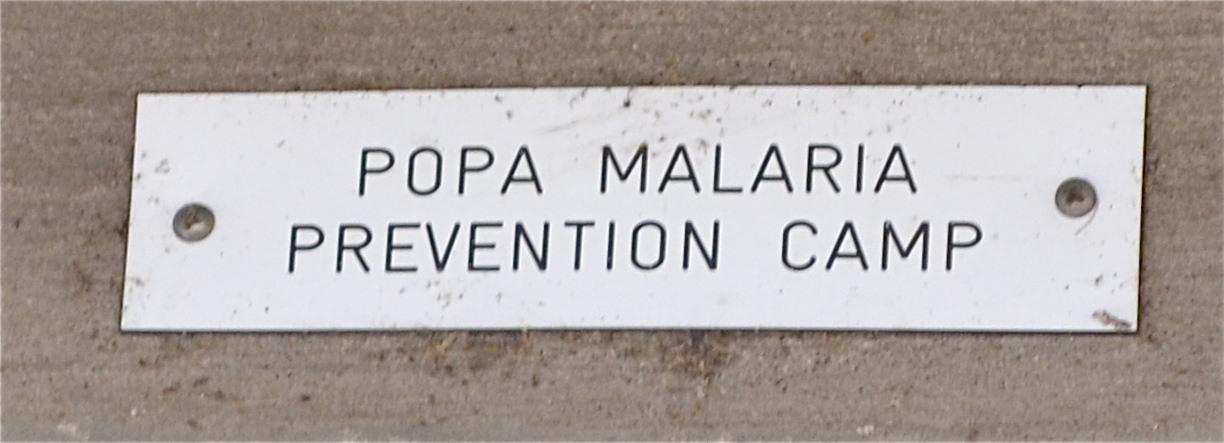
Nathan is assigned to the Popa Malaria Camp, which is where regional mosquito control efforts are based out of.  


Nathan's hut. He can hear hippos in the river behind the hut at night and had to help one of his host brothers chase a Hippo off their property last week.

One of Nathan's host brothers.

We found this snake skin not very far from Nathan's room at the Malaria Camp.   That'll make you watch your step. 


 My favorite photo of the week I took during a walk near the Popa Malaria Camp in Divundu. 


That's it for this week.  I may be quiet for the next two weeks as my workshop will likely take over my life.  However, I'm sure I'll return with more than a few good stories.  I hope you are all well.  Thanks for reading. 

Friday, June 1, 2012

I can't stare at this title line any longer. I can't think of a good title. Just read the post and forget the title. It's just a title. It's really not that important.


I’m growing a mullet and I have a cat in my apartment named dieciocho, or ocho for short.  It's not my cat.  The cat belongs to my housemate, Gio.  It didn’t have a name.  Well, it had a name but Gio forgot what it was.  I call that not having a name.  He said, “its name is Rukwangali for hiccup, but I forget what that word is.  It’s really long”.  Her name is Ocho now.


The mullet is a Peace Corps NAM35 Mullet Club requirement.  We have 2.5 members.  The .5 is rock-star Rob whose commitment level to the club is debatable.  I guess the take away here is that you can all look forward to a picture of me rocking a hardcore mullet by late summer or early fall.  Nothing commands respect like a man with a mullet in a suit.  Part of my mission here is to expose Namibians to American culture.  And though the mullet is not my culture, there are some in America who sport them proudly and that’s good enough for me. 

Long before my mullet comes in, I will be facilitating a large Business Plan writing workshop.  Preparing for the workshop has kept me busy.  It’ll be a 3-day event and will include one day on business plan writing, a second day on financing start ups, and a third day that will be on Rundu small business success stories.  Besides developing all of slides and handouts, I also need to worry about things I have little experience with (particularly in Namibia) such as food, facilities, and identifying and inviting guest speakers.   It’s been many months since I left my job at Alere and it’s nice to be work-busy again.  I never anticipated having this sort of gig in the Peace Corps, but at least it feels familiar.

As promised, here are some photos of some of my daily sights;

First, we have my lunch friends, Maria (red hat) and Kito in their restaurant/bar.  

Maria - left, Kito - right

Some sites on my walk back to work after lunch;
This is the road Kito's place is on.


Some young entrepreneurs I chat with on the walk back to the office.  They just started a little car wash and were excited to show me the puppy they just bought.  

 This is where I get my fat cakes (fried dough, so good, so cheap, so not good for you).   This is an Angolan family.  They never smile.  Ever.  It has become a mission of mine to get them to smile at me.  Just once. 

On this particular walk home I struck up a conversation with two men, Albinus and John.  They're brothers and they live in an informal location near the youth center.  Binus wanted to show me a certificate he'd gotten a few years ago from the Red Cross.  He'd once done volunteer work for them and was hoping to find similar work.  He makes a little money by catching fish in the Kavango river and selling them to people in his neighborhood.  After about 30 minutes of conversation on where/how he might find some other sources of income, he mentioned a farm his family owned about 15 miles outside of town.  He said there was a lot of lumber on the land and that much of the fire wood used in Rundu came from the same area.  

We started talking about a fire wood business (firewood is big here because many don't have electricity and have to cook over fire).  John (right) said he'd sold firewood in the past and thought he could sell a lot of it if they could just get it back to the home.  We talked a bit about how much it would cost to hire a truck and how much they could make from a truck load of firewood.  They said they would talk to some people and find out how much it would be to hire a truck.  I'll visit them again next week to see how their plans are coming. 
Binus (left) and John (right)

This is their house.


Sometimes there is a language barrier and drawings in the sand go a long way to get over these little hurdles.  This is me clarifying what these gentlemen mean by a "4x4 truck" and "2.6 Namibian after truck".  

I work in a modern building.  The full name of the facility is "The Rundu Multipurpose Youth Resource Center".  This is our receptionist, Venicia.  She never stops smiling. I should bring her to get fat cakes with me someday so she can give the Angolan family a smiling lesson.   

This is our intern, Leticia and her grandmother.  

This is my counterpart, Mr. Kamushambe.  He is the director of the youth center.

This is my office spider.  It's a wall spider.  They're everywhere here.  You hardly notice them after a while.  

Besides the modern apartment and a nice office, another thing that makes my Peace Corps experience a lot different from many others' in my group is my access to internet.  It's very rare here to have fast free wifi available.  It's nice to be able to keep up with friends and family when you're so far from home.  Here's my ever faithful friend, Rosellen.  She lives in Italy and she doesn't like getting her picture taken. 

I'm a laundry (hand washing) pro now.  Only takes about an hour.  This is what the beginning of the process looks like.  

This is my apartment (in the middle of cleaning).

The view of my laundry drying from the back room window.  Yes.  Exciting.  

This guy showed up in my yard when I was taking pictures so now he's in my blog.

The front of my place.

 
This is Emanuel and Uno.  They're host siblings to my friend, Alice (PCV).  They're getting ready to show me how well they sing.  I was invited to their house to celebrate Alice's birthday.

This is PCV Alice (sitting).  Her host family hard at work preparing her birthday dinner. 

Meat getting grilled for Alice's birthday party.  

 Here are some random shots of people and places around my neighborhood;

My favorite photo of the week.  These girls hang out in the park near my house.  They think it's hilarious when I try to speak to them in Rukwangali.   It's very common to see a young girl hauling an even younger child on her back as seen here.  Kids start to help caring for younger siblings at a very early age in Namibia. 


Some of the neighborhood boys.  There are so many kids here.  You almost never see boys playing with girls here.  

Neighborhood barber shop.  

Shop owner.  Super nice guy.  The road rash is from falling off the back of a truck.  I didn't ask for further details though I wanted to.  I don't think I'd be able to get a proper mullet here. 


Sunset over the Kavango River.


That's it for this week.  Please note I've updated my mailing address over there on the right side of your screen.  I've also added a couple other blogs I've been following.  I hope to post a more wordy blog next week.  I hope you are all well.  Thanks for reading. 

Thursday, May 24, 2012

Photo Friday on Thursday


Photo Friday and a quick post. OK, my first photo Friday is occurring on a Thursday.  Friday is a holiday here and I only have internet at my office. I’ve decided to begin posting one or more photos on Friday along with some of my more random thoughts and experiences.  So, these Friday (Thursday) posts may be a bit sloppy. 

You know that moment in a dream when you start to realize it’s a dream?  That moment that the word “dream” hasn’t entered your mind yet, but you begin to question the reality of what you’ve just been experiencing?  That feeling has occurred to me a few times here while I was awake.  I had one of those moments last Saturday morning as I stood looking out the back door of my flat, eating my guacamoatmeal breakfast (not Namibian) out of my big Herero cup (blue, not yellow) and wondered how I might spend my weekend.    A man came to my back fence and asked if he could clean up my yard.  Across the street behind him a woman walked with a flaming stick, followed by one young boy naked from the waist down and two skinny dogs.  She was setting the brush on the side of the road on fire.  Then a precession of cars and pickup trucks packed with passengers passed by, kicking up dust and blocked the fire lady from my view.  I asked the man at my fence what the precession was for.  He said “a wedding”.  I asked him how long the wedding would go for and he told me it would take the entire weekend.  He then called me by my name.  I had no idea who the man was or how he came to know my name.  Perhaps one of my neighbors told him about their new American neighbor.  You’re left scratching your head here a lot.  I told him “thanks, but I don’t need my yard cleaned up.”  To which he gave my yard a disapproving look.  I then said “Ame mulizambeli.  Randa kwato.” Which means “I’m a volunteer, I have no money”.


Oftentimes, people look at me here like a potted plant might burst out of my ear at any moment.  Nobody wants to miss that.  Sometimes I walk the 3 miles home from my office to get more familiar with the neighborhoods of Rundu.  I’ll stop at a few shops and buy something small, sometimes food, sometimes a bottle of beer, sometimes some candy to hand out, and I try to speak a bit of Rukwangali with the shopkeeper.  This is met with varying levels of delight and confusion.  Cars pass by outside the shop door, kicking up dust, the always-present Namibian children staring at me with curiosity or awe or completely dumbfounded.  The shopkeeper, protected behind a steel cage, bars wide enough to hand me whatever I’ve pointed out and paid for, does their best work with my limited Rukwangali.   

During my commute home, I walk through both “formal” and “informal” locations.  The informal settlements tend to be the poorer areas, mostly consisting of corrugated metal (what they call “zinc”) shacks, and mud and stick huts on dusty sand drives.  I pass a Tumbo joint everyday on my way to lunch.  Tumbo is sort of homemade fermented beverage that packs a punch.  Everybody inside and outside of the tumbo shack is pretty haggard.  Tumbo costs N$1 (that’s 1 Namibian dollar which is less than 20 cents American) for a large mason jar full.    All the women sit in a row against the outer fence wrapped in dark dirty clothes.  The men sit in small groups on the ground, on old tires, or on the few benches available.  Mason jars filled with the brownish yellow used-turpentine-looking tumbo are passed.  There are always a few noticeably intoxicated people moving about and sometimes a few lying on the sandy ground of the open air establishment.   The scene doesn’t change much from noon until 5:00PM or from day to day. 

I eat lunch nearly everyday with a woman named Keto.  She’s one of three female owners of a restaurant/shebeen (a bar) in location near where I work (about a block from the Tumbo joint).  Her business is clean and appears to be well run.  Keto runs the restaurant, which consists of about 4 options served out of large catering pans and a few picnic style tables under an awning that is attached to the bar.  I typically get chicken, porridge, and mutete (sort of a stewed spicy spinach).  Keto patiently answers my questions regarding Namibian business practices and how she and her sisters (I doubt they are really her sisters) managed to save enough money to open the business.  I’m sure she has little idea what to make of me or my questions, but she seems curious and entertained and genuinely happy to see me. 

Sometimes Keto sips beer while we chat.  She always gives me way too much food and I slide my plate over to her when I’m done and she finishes it.  Twice a mentally challenged man came in, a fixture at the tumbo joint, with a gray beard and deeply wrinkled face, carrying his homemade toy rifle and speaking quickly and endlessly to me in Rukwangali.  “He’s saying you shouldn’t be scared of him” Keto tells me.  I say “I know, please tell him I’m not.”  (And I really am not.  Besides having a few things stolen here and dodging cars, my experiences with Namibians have been good).  Keto then gives my plate to the man to finish.  He walks off into sun and dust outside with his toy gun slung over his shoulder and then returns about a minute later with an empty plate.   

I love Namibian pedestrians.  The drivers I could do without.  My experience so far strongly suggests that Namibians, when driving a car, are wholly unconcerned with anything other than their destinations.  The gas, break, and steering wheel are tools used only to manipulate a car toward a destination.  Any human that might cross their path is, constructively speaking, invisible.  I might as well be a pigeon.  I have some experience with this from my days in Vietnam.  Running is an interactive experience here.  I ran at night once.  The sand looked like snow in the light of the approaching cars.  Looking up I had bouncing headlights intermittently blinding me.  When I didn’t have headlights in my face, my visibility was limited by all of the smoke and dust in the air (people set brush fires here a lot.  I believe to remove habitats for snakes).  Looking down I could only see the confused shadows of drifted sand made more confusing by the shifting light.  Long story short, I’ll run in the morning or not at all.  Namibian drivers seem to sleep in. 

My work is going well so far.  I’ve already started some work on multiple projects.  I’ll be facilitating a large business plan writing workshop next month.  I’ve also started working on a female empowerment through entrepreneurship workshop, though real work on that will have to wait until after the business plan writing workshop.  My pet project is an exercise and nutrition club here at the youth center.  I'm pursuing this project for purely selfish reasons.  I’m pretty much just trying to get a bunch of kids to work out with me in the afternoon a few days a week.  I’ll stick a talk at the end of each session on health or nutrition or malaria…I’ll make it work. 

Thanks for reading.  My goal for next week is to take a number of photos of the things I see daily so that you can see a bit more of what I see everyday.  

My favorite photo of the week is not mine and is not from this week.  I hope you like it.  (Thanks to Vilhelm G. Wilmason aka Pam) 
Photo hunting in Omaruru.  PGW

Tuesday, May 15, 2012

18 million years


It’s been a busy three(+) weeks since my Rundu site visit.  Besides training, I had to prep for my final language exam and mentally prepare to be separated from the gang of other trainees that I’ve formed some pretty strong bonds with over the past 8 weeks.  As I begin to write this, I am sharing the backseat of a Neon sized vehicle with two other newly sworn in U.S. Peace Corps Volunteers, Geri and Nathan.  We’re headed on a 9-hour journey to our permanent sites to start our 750 days as PCVs in the Kavango region.   

My training in Omaruru ended about one week ago.  I spent this past week in a mountain lodge with the rest of the trainees.  It was nice to have the whole gang back in one spot for a few nights.  I passed my Rukwangali language proficiency exam and was sworn in as a US Peace Corps Volunteer on Friday.  I arrived in my permanent site Saturday.  As usual, way too much has occurred over the past three weeks to cover it all, so I’ll hit some of the high points, low points, and other oddities. 

The deepest low was finding out that our most loved team member, Cathey, would be going home.  Cathey was the undisputed heart of our group.  She was a champ everyday.  If she ever had a bad day, she never showed it.  She always did whatever she could to keep everybody’s spirits up.  She cared about all of us and never had anything but words of encouragement.  We’ll all feel her absence.  

Cathey and the guys


The high of my past three weeks occurred during a morning run with my friend Pam.  My morning run, many times, is the highpoint of my day.  That’s not to say there aren’t many other good moments, but the beauty of this place in the morning, particularly Omaruru and Windhoek, is hard to top.  The rest of the day sort of has the deck stacked against it.  Add the mountains of Windhoek into the mix and forget about it.  So, anyway, the story goes like this;

I met Pam at about 6AM for our first Windhoek mountain run.  We’d spotted a trail the night before from the back deck of the lodge and decided to give it a shot (Pam later reminded me).  We first ran to a circular building on the top of the first peak (photo below) that appeared to be an old lookout.  We reached it in time for the sunrise and then proceeded to the next peak, which provided a beautiful view of Windhoek far below.   

The beginning of our run (see the little outlook on top?)
We had just started our run back to the camp when I heard some strange grunting sounds.  I’d heard a deep grunting sound during our run out but figured it was some sort of cattle in the valley.  I looked off to the west and saw three dark figures perched on a rocky outcropping atop an adjacent peak.  At first, I thought that they were hikers, but I then wondered why they were all wearing the same dark outfits.  I then noticed movement much closer on the hillside that slopped away from me and spotted a dark face looking back at me.  And then another. 

When I took in the whole valley in I couldn’t believe I’d just run through this scene and had not noticed the 30 or so baboons that were wandering between the two peaks.  I was surprised at their size.  They're much bigger than I thought they were.  There were two large baboons that were watching Pam and I closely.  The rest spread out through the shallow valley behind them and up to the next peak.  Pam pointed out some babies running up toward the rock outcropping I’d spotted the first ones perched one.  It turned out that the first ones I saw were the furthest away.  The closer guards watching us were a little more than 150’ away.  The big group appeared to be passing through.  I saw one that was walking on a piece of road that we’d just run twice and the direction of the group suggested that they’d just crossed our route.  I wondered if we’d split the group as we ran out.  I wondered how long ago we shared a common ancestor.  I wondered if we should be worried.    My friend and I were on a mountain top just after sunrise, in Africa, and alone with a large pack of baboons.  It was beautiful.  We stood for a short while in the cool quiet morning and took the scene in and then continued on our run. 

Some other events of the last three weeks included an American Food Day, during which the PCTs got to make American dishes for their host families.  I made German potato salad.  I know, it’s German, not American.  But it’s also a pretty common item at picnics in Pennsylvania and I figured it'd be a crowd pleaser.  We also had a sheep slaughtering party.  After the whole chicken thing, this wasn’t too hard to handle.  The actual slaughter was a bit hard to watch at moments, but that didn’t stop me from getting about 100 pictures.  PCV rock-star Rob did the hard part.  The party started with the sheep tied to a tree and ended with it in our bellies.  It was impressive to see how quickly a few Namibians could slaughter, gut, butcher, and prepare a sheep for dinner. 

Leaving Windhoek and the NAM 35 gang was harder than I thought it would be.  When I met them all in Philly, I figured we’d only be together for 8 weeks and wondered how close we could actually get in that time period.  Turns out you can get pretty attached in 8 weeks.  They’re a great group of people and I’m looking forward to seeing them all in three months.  

Sorry for the brief post.  I’m now sitting in my office at the Rundu Youth Center (yes, I know I started in the backseat of a car on my way to Rundu, but even these little posts take time).  I’ll be more connected now that I’m at my permanent site, so expect my normal posts every two weeks.  But, right now, I have a ton of work to do to get my head wrapped around what needs to get done here and how to approach it.  Thanks for reading.  I'll leave you with a few photos from the past weeks.  I hope you are all well.  


The gang at swearing in

The men of NAM 35

I took a walk in one of the unofficial locations one morning.  This was my favorite shot of the day.

Photo from a bar in Omaruru.

Some of the gang taking in the sunset at the Windhoek mountain lodge